
Masseria Cuturi
Manduria, Puglia, Italy
Let us tell you about a place in southern Italy that quietly captures the spirit of Puglia better than most guidebooks ever could. Masseria Cuturi sits just outside the town of Manduria in the deep heel of Italy’s boot, not far from the Ionian Sea. It is the sort of place where the landscape feels ancient and agricultural rhythms still shape everyday life. Vineyards, olive trees, wind, limestone soils, and the slow patience that good farming demands.
The estate itself dates back to 1881, when a wealthy landowner from Manduria, Tommaso Schiavoni Tafuri, married Countess Sabini from Altamura. As part of her dowry, she brought something rather unusual for the time. Grafted vine cuttings of Primitivo. These “rooted cuttings” were planted on the estate’s land in a fertile basin known locally as the Conca d’Oro. That planting turned out to be quietly historic. The vines thrived in the rich soils and warm climate, producing wines deeper and more alcoholic than many Apulian wines of the time. The grape itself would eventually take the name Primitivo, referring to its early ripening compared to other varieties.
By the late 19th century, the estate had expanded to around 100 hectares of bush-trained vines, tended with enormous care by the local community. Even in the early twentieth century, Masseria Cuturi was experimenting with new winemaking techniques and earning recognition across the region, firmly embedding itself in the wine history of Manduria. Then, as so often happens in rural Italy, the vineyards slowly faded away.
When Camilla Rossi Chauvenet arrived in 2007, they found the historic masseria without vineyards at all. What they saw instead was possibility. The chance to restore a piece of Manduria’s agricultural heritage. The project became a long and patient rebirth, and today roughly 40 hectares of vineyards have been replanted across the estate.
The geography here is fascinating if you are even mildly geeky about terroir. The vineyards lie within the Conca d’Oro, whose name literally comes from the fertility of its soils. Underground water is abundant thanks to five artesian wells and two natural springs, making the area unusually generous for agriculture. Nearby lies the Cuturi forest, an ancient woodland of about 35 hectares of towering oak trees and dense Mediterranean scrub whose aromas of mastic, rosemary, and broom surround the vineyards. The forest is protected within the Oriental Taranto Coastal Natural Reserve and represents only a small surviving fragment of what was once the vast Arneo Forest, a woodland that once stretched across thousands of hectares in this part of Salento. The vineyards themselves sit in what is essentially a single broad parcel near the Ionian Sea, divided by traditional dry stone walls into smaller parcels. Many of the vines are planted from ancient clones of Primitivo, each showing slightly different characteristics.
Soils shift constantly across the property. Some areas are very dark and clay-heavy while others are marl-rich with hints of silt. The ground is deep, soft, and unusually rich in organic matter. To keep the vines balanced, grasses are planted between rows to oxygenate the soil and create gentle competition among the plants.
Farming here is fully organic. No pesticides, no herbicides, no synthetic fertilizers. Wild plants that grow naturally in the vineyard are treated as allies rather than weeds. Green manures, often beans or grasses, are planted between rows and buried in spring to nourish the soil. The idea is simple. Let the vineyard function as a living ecosystem.
The cellar philosophy follows the same logic. In the days of Tommaso Schiavoni the winery was not even located on the estate. It was kept in the city for fear of brigands roaming the countryside. Today, vinification happens inside the Masseria itself, just steps from the vineyards that produced the grapes. This closeness allows the team to track the maturation of each parcel carefully and harvest with precision. Fermentations are done in small tanks for microvinification, allowing individual vineyard plots to express themselves. Oak is used sparingly, just enough to frame the wines without masking their natural character. Bottling takes place directly at the estate.
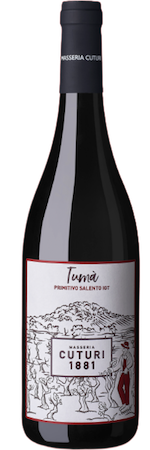
The wines themselves are a thoughtful exploration of the region’s native grapes. Bottles like Segreto di Bianca, Zacinto, and Tumà highlight the indigenous varieties, focusing on brightness and drinkability. They show the character of the land while maintaining surprising lightness and freshness, something not always expected from southern Italy.
Much of the estate’s modern vision is guided by Camilla Rossi Chauvenet, who arrived from northern Italy and quickly fell in love with Masseria Cuturi. In a region traditionally known for powerful reds, she pursues a different expression of Manduria, crafting wines she jokingly calls “soap and water wines”: fresh, light, and pure. And honestly, that is the kind of wine we love most. The one that let the place do the talking.
Wines by this Producer
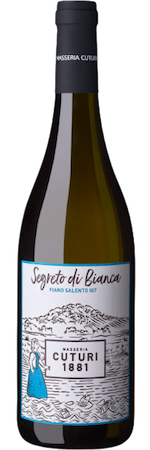
2025 Fiano Salento IGT Segreto di Bianca
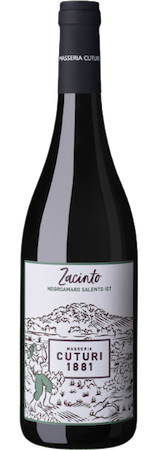
2024 Negroamaro Salento IGT Zacinto