

Contucci
Montepulciano, Toscana, Italy
In Montepulciano, the Contucci name comes up with the sort of regularity usually reserved for old friends and local landmarks. After centuries of farming these hills, the family has become so intertwined with the town that it's hard to tell where one story ends and the other begins.
The Contucci family traces its winemaking roots back to 1008. That’s not a romantic exaggeration, there are documents to prove it. For more than 40 generations, the family has cultivated vines on the hills surrounding Montepulciano, making them one of the oldest continuously operating wine families in Italy. To put that in perspective, the Contucci family was already working these vineyards when the Vikings were still roaming Europe. By the 1700s, wine had begun to take shape, and the Contucci family became one of the early champions of what would come to be known as Vino Nobile di Montepulciano. A document from 1773 already describes it as “a noble wine destined for the table of nobles."
What makes the Contucci story especially fascinating, though, is where the winery actually sits. Instead of being hidden out in the countryside, the historic cellar lies directly beneath Palazzo Contucci, overlooking Piazza Grande. Beneath the palace stretches a network of historic tunnels and chambers spread across three underground floors, a quiet labyrinth of barrels, fermentation tanks, and aging bottles carved into the stone beneath the town. While tourists above stroll through the square and enjoy gelato in the Tuscan sun, wine continues to age quietly below their feet. Contucci remains one of the last estates where the entire winemaking process still takes place in the historic center of Montepulciano, making the experience feel almost like stepping into a living piece of wine history.
Outside the town walls, the estate itself covers about 170 hectares of land, although only 21 hectares are planted with vines. ~ 15 hectares are dedicated to Vino Nobile, while the remaining vineyards produce wines such as Rosso di Montepulciano, Vin Santo, and Bianco della Contessa, a white wine named in honour of the women of the family. These vineyards lie across the hills surrounding the town at elevations between roughly 280 and 450 meters above sea level. During the Pliocene era, much of this part of Tuscany was covered by ancient seas, leaving behind layers of marine sediments, clay, sand, and fossils that still influence the structure of the wines today. Adding another layer to the story is nearby Monte Amiata, an ancient volcano whose eruptions scattered volcanic material across parts of the region. For anyone obsessed with terroir, that marriage of marine fossils and volcanic material is pure magic!
In the vineyards, the Contucci family focuses almost entirely on traditional local varieties. The most important is Prugnolo Gentile (the local name for Sangiovese), alongside Canaiolo Nero, Mammolo, Colorino, Trebbiano Toscano, Malvasia del Chianti, and Grechetto. Vineyard practices are tailored to each vintage, and all grapes are hand-harvested and gently placed in small boxes to ensure they arrive at the cellar in optimal condition.
Back beneath Palazzo Contucci, the historic cellar handles fermentation and aging using a combination of traditional and modern equipment. Grapes are fermented in concrete and stainless steel vats, and then aged in oak casks (Slavonian, French, Austrian) with additional storage in steel and concrete vessels. In total, the estate produces somewhere between 70,000 and 100,000 bottles per year, depending on the vintage. Some wines are even aged for extraordinarily long periods, sometimes 40 or 45 years, and the cellar still holds historic bottles dating back as far as 1887.
Today, the estate is run by Andrea Contucci, a quietly humble man carrying a thousand years of family history on his shoulders. His family helped shape Montepulciano centuries ago, but Andrea is not interested in titles or prestige and is focused entirely on the land and the wine. In a world obsessed with speed, there's something quietly comforting about a cellar that refuses to hurry. Somewhere beneath the cobblestones of Montepulciano, another barrel of Vino Nobile is aging patiently, blissfully unaware of trends, algorithms, or whatever the rest of us are rushing around for.t.
Further on Contucci from John Fodera’s Tuscan Vines:
"Andrea Contucci traces his family’s wine-making roots to the year 1008. But, although that’s impressive, that’s not what makes this gentle man special. Despite the fact that Andrea’s family is Nobility who, along with a handful of other families, essentially founded Montepulciano, Contucci is as humble and soft-spoken as can be. The family’s Palazzo stands on the Piazza Grande in Montepulciano directly across from the Town Hall. It’s almost impossible to visit Montepulciano and miss it. It’s a fixture on the Rustic Tuscany Tour and with good reason. Andrea’s wines are as charming as he is. Contucci is Montepulciano.
Given the winemaking lineage, you might expect the family wines to be traditional. To a certain degree, that is correct. The quartet of Vino Nobile produced contain no international grapes. Additionally, unlike other Houses that have moved toward 100% Sangiovese for Nobile, Contucci still blends the wine with other native varietals like Canaiolo, Colorino and Malvasia Nera. […] Despite this respect for tradition, they are not intent to blindly rest on their laurels. Innovation constantly takes place from fermentation to vinification. Wood types and barrel sizes have evolved over the years to include not only Slavonian Botte, but also French Tonneaux and now Austrian oak.
A visit to the Contucci Cellars begins with a descent to the depths of the “catacombs” beneath the family home which date back over one thousand years. No nook or cranny has been wasted. Cement fermentation tanks are seamlessly built into walls. Niches are filled with painstakingly stacked Nobile resting until maturity. Space is at a premium but has been masterfully utilized. As you walk with Andrea through his ancient workspace, your anticipation to taste his wine builds. His dedication and passion are almost tangible. I must admit, it’s rather inspiring. Many wine cellar tours are quite similar. But Contucci is unique and clearly different. Despite using a winery whose space limits the way in which the family can work, the resulting wines are incredibly well made; as if they were produced in the most modern of facilities." — John Fodera, November 22, 2024

Wines by this Producer
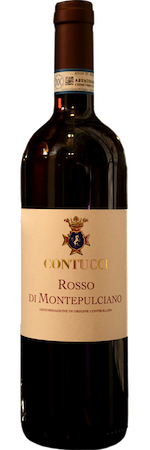
2024 Rosso di Montepulciano DOC
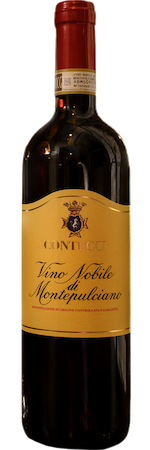
2021 Vino Nobile di Montepulciano DOCG
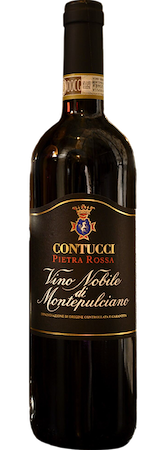
2021 Vino Nobile di Montepulciano DOCG Pietra Rossa
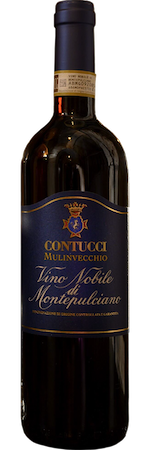
2021 Vino Nobile di Montepulciano DOCG Mulinvecchio