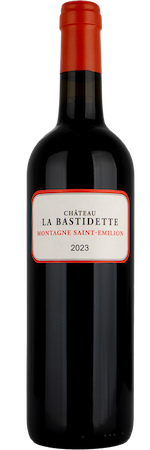
Château La Bastidette
2023 Montagne-Saint-Émilion AOC
After lunch with Julien Noël at La Table de Catusseau, a tiny Pomerol spot where you’re never far from the who’s who of the Right Bank, we drove three kilometres north toward his Château Moncets in Néac. We climbed gently onto that famous 35–38 metre plateau of sticky blue clay, and suddenly the names started rolling past like an all-star team: Le Pin on the left, then Vieux Château Certan, Pétrus, Lafleur just beyond it, and Lafleur-Gazin a moment later. These legendary estates are all surprisingly modest in scale, tucked quietly among old Merlot vines.
Then, almost as quickly, the road dipped. We crossed the smallest, most insignificant-looking bridge over the Barbanne, curved right, and climbed straight back up to almost exactly the same elevation. The same sticky blue clay. The same Günzian gravels. Only now we were in Néac, where Julien’s sister estates, Château Moncets and Château de Chambrun, sit on what I think is some of the most undervalued vineyard land in Bordeaux.
The reason is almost entirely historical. The Barbanne became the dividing line between Pomerol and Lalande-de-Pomerol, just as it helps separate Saint-Émilion from its satellites. Those boundaries were drawn long before the kind of detailed soil mapping we have today. Most of Lalande-de-Pomerol does sit on lighter soils, often silt or sand over gravel and clay, and that can give softer, more perfumed, earlier-drinking Merlot. But right along the Barbanne, the geology changes very little. Study the soil maps and you can see it; stand there in person and it becomes impossible to ignore. That day felt a little like finding a first-edition Walt Whitman in a dusty second-hand bookshop. I’ve been obsessed with these wines ever since.
So I was genuinely excited when I learned that Julien and Antoine had found another piece of undervalued Right Bank terroir nearby, this time at Château La Bastidette. The value proposition is similar to Chambrun and Moncets, only the geology is different. Bastidette sits on the limestone side of the Barbanne, where Montagne-Saint-Émilion begins to resemble the western edge of Saint-Émilion itself. The vineyard is only about 750 metres from the northernmost plots of Château Cheval Blanc, with limestone sand over the heavy blue clay of the plateau.
It is an historic Merlot vineyard divided into seven parcels, including one planted in 1929. That old parcel is especially important, as it provides material for massale selections used not only at Bastidette but also at Chambrun and Moncets. With the slightly higher elevation and limestone influence, the Merlot takes on a cooler, more lifted character than the fruit from their Néac vineyards.
That difference in expression is exactly why they choose to age Bastidette in concrete rather than oak. Julien took me inside one of the new Italian vats he had just installed, and he was as excited about them as most people would be about a new sports car. These are thermoregulated, epoxy-free concrete parcel tanks, fed by gravity and supported by a new vibrating sorting table, a DREAM+ destemmer and densimetric sorting system. It was a lot of fun watching a winemaker completely geek out over cellar equipment.
And in this case, the equipment makes perfect sense. The concrete allows the fruit to develop fully without weighing down the wine’s naturally fresher, medium-bodied profile. At around 13% alcohol, Bastidette does not need the expensive jewellery and fur coat of new oak. That treatment works beautifully for the deeper, more powerful Néac fruit, but here it would risk covering the very thing that makes the site interesting. Concrete keeps the wine supple, pure and lifted, and gives Julien and Antoine a gentler expression of Right Bank Merlot that works beautifully with lighter dishes.
What makes Bastidette even more fascinating is just how abruptly the terroir changes in this tiny area. Jane Anson makes the point beautifully in Inside Bordeaux: east of Néac, Montagne-Saint-Émilion shares the limestone geology of Saint-Émilion, while that limestone is almost completely absent from Néac and Lalande-de-Pomerol. There is an unusually clear geological dividing line between the appellations.
From the back of the château, you can see the tiny bridge over the Barbanne where four appellations almost collide: Montagne-Saint-Émilion, Lalande-de-Pomerol, Pomerol and Saint-Émilion. The striking part is that the limestone of Montagne and Saint-Émilion simply does not continue into Pomerol and Lalande in the same way. Bastidette sits right at this transition, just over the Barbanne from the western edge of Saint-Émilion.
Since purchasing the property in 2022, Julien and Antoine have moved quickly toward organic farming. Selected cover crops such as mustard, clover and nettles are sown according to the needs of each parcel, helping with water retention, biodiversity and pollinator activity. Drones are used to study water stress, leaf fall and differences across the vineyard, while the soils are worked manually to encourage the roots to travel deeper.
It is still early days, but the 2023 vintage already shows why they were so excited about this place. Bastidette has the ripe, generous fruit you want from Right Bank Merlot, but with a cooler, fresher shape and a purity that feels completely tied to its limestone soils. Blackcurrant, dark cherry and violet lead the way, with a rounded, concentrated palate and enough freshness running through the wine to keep all that fruit beautifully in balance.


Region: Montagne-Saint-Émilion, Bordeaux
Appellation: Montagne-Saint-Émilion AOC
Varietal/Blend: 100% Merlot
ABV: 13%
Vineyard & Vine Age: 5.36 hectares of approximately 35-year-old vines planted at 6,000 vines per hectare on sandy dark clay. Naturally grassed and currently in conversion to organic farming.
Cellar: Grapes are hand-harvested and received by gravity. Each parcel is vinified separately in temperature-controlled, epoxy-free Italian concrete tanks, followed by six months of aging on the fine lees in concrete.
CSPC: 149707
Winemakers Note: []
What the Critics are saying: []
Region: Montagne-Saint-Émilion, Bordeaux
Appellation: Montagne-Saint-Émilion AOC

After lunch with Julien Noël at La Table de Catusseau, a tiny Pomerol spot where you’re never far from the who’s who of the Right Bank, we drove three kilometres north toward his Château Moncets in Néac. We climbed gently onto that famous 35–38 metre plateau of sticky blue clay, and suddenly the names started rolling past like an all-star team: Le Pin on the left, then Vieux Château Certan, Pétrus, Lafleur just beyond it, and Lafleur-Gazin a moment later. These legendary estates are all surprisingly modest in scale, tucked quietly among old Merlot vines.
Then, almost as quickly, the road dipped. We crossed the smallest, most insignificant-looking bridge over the Barbanne, curved right, and climbed straight back up to almost exactly the same elevation. The same sticky blue clay. The same Günzian gravels. Only now we were in Néac, where Julien’s sister estates, Château Moncets and Château de Chambrun, sit on what I think is some of the most undervalued vineyard land in Bordeaux.
The reason is almost entirely historical. The Barbanne became the dividing line between Pomerol and Lalande-de-Pomerol, just as it helps separate Saint-Émilion from its satellites. Those boundaries were drawn long before the kind of detailed soil mapping we have today. Most of Lalande-de-Pomerol does sit on lighter soils, often silt or sand over gravel and clay, and that can give softer, more perfumed, earlier-drinking Merlot. But right along the Barbanne, the geology changes very little. Study the soil maps and you can see it; stand there in person and it becomes impossible to ignore. That day felt a little like finding a first-edition Walt Whitman in a dusty second-hand bookshop. I’ve been obsessed with these wines ever since.
So I was genuinely excited when I learned that Julien and Antoine had found another piece of undervalued Right Bank terroir nearby, this time at Château La Bastidette. The value proposition is similar to Chambrun and Moncets, only the geology is different. Bastidette sits on the limestone side of the Barbanne, where Montagne-Saint-Émilion begins to resemble the western edge of Saint-Émilion itself. The vineyard is only about 750 metres from the northernmost plots of Château Cheval Blanc, with limestone sand over the heavy blue clay of the plateau.
It is an historic Merlot vineyard divided into seven parcels, including one planted in 1929. That old parcel is especially important, as it provides material for massale selections used not only at Bastidette but also at Chambrun and Moncets. With the slightly higher elevation and limestone influence, the Merlot takes on a cooler, more lifted character than the fruit from their Néac vineyards.
That difference in expression is exactly why they choose to age Bastidette in concrete rather than oak. Julien took me inside one of the new Italian vats he had just installed, and he was as excited about them as most people would be about a new sports car. These are thermoregulated, epoxy-free concrete parcel tanks, fed by gravity and supported by a new vibrating sorting table, a DREAM+ destemmer and densimetric sorting system. It was a lot of fun watching a winemaker completely geek out over cellar equipment.
And in this case, the equipment makes perfect sense. The concrete allows the fruit to develop fully without weighing down the wine’s naturally fresher, medium-bodied profile. At around 13% alcohol, Bastidette does not need the expensive jewellery and fur coat of new oak. That treatment works beautifully for the deeper, more powerful Néac fruit, but here it would risk covering the very thing that makes the site interesting. Concrete keeps the wine supple, pure and lifted, and gives Julien and Antoine a gentler expression of Right Bank Merlot that works beautifully with lighter dishes.
What makes Bastidette even more fascinating is just how abruptly the terroir changes in this tiny area. Jane Anson makes the point beautifully in Inside Bordeaux: east of Néac, Montagne-Saint-Émilion shares the limestone geology of Saint-Émilion, while that limestone is almost completely absent from Néac and Lalande-de-Pomerol. There is an unusually clear geological dividing line between the appellations.
From the back of the château, you can see the tiny bridge over the Barbanne where four appellations almost collide: Montagne-Saint-Émilion, Lalande-de-Pomerol, Pomerol and Saint-Émilion. The striking part is that the limestone of Montagne and Saint-Émilion simply does not continue into Pomerol and Lalande in the same way. Bastidette sits right at this transition, just over the Barbanne from the western edge of Saint-Émilion.
Since purchasing the property in 2022, Julien and Antoine have moved quickly toward organic farming. Selected cover crops such as mustard, clover and nettles are sown according to the needs of each parcel, helping with water retention, biodiversity and pollinator activity. Drones are used to study water stress, leaf fall and differences across the vineyard, while the soils are worked manually to encourage the roots to travel deeper.
It is still early days, but the 2023 vintage already shows why they were so excited about this place. Bastidette has the ripe, generous fruit you want from Right Bank Merlot, but with a cooler, fresher shape and a purity that feels completely tied to its limestone soils. Blackcurrant, dark cherry and violet lead the way, with a rounded, concentrated palate and enough freshness running through the wine to keep all that fruit beautifully in balance.
TECHNICAL INFO
Varietal/Blend: 100% Merlot
ABV: 13%
Vineyard: 5.36 hectares of approximately 35-year-old vines planted at 6,000 vines per hectare on sandy dark clay. Naturally grassed and currently in conversion to organic farming.
Cellar: Grapes are hand-harvested and received by gravity. Each parcel is vinified separately in temperature-controlled, epoxy-free Italian concrete tanks, followed by six months of aging on the fine lees in concrete.
CSPC: 149707
Winemakers Note: []
What the Critics are saying: []
Giovanni Autuori
Calgary + Alberta South
T: 403-971-1898
E: giovanni@vinoalvino.ca
Joe Gurba
Edmonton + Alberta North
T: 780-203-5284
E: joeg@vinoalvino.ca
New Title
New Title
New Paragraph

TECHNICAL INFO
Country: France
Region: Montagne-Saint-Émilion, Bordeaux
Appellation: Montagne-Saint-Émilion AOC
Climate:
Altitude:
Soils:
Varietal/Blend: 100% Merlot
Fermentation: Spontaneous fermentation with native yeasts in old oak puncheons.
Ageing:
Vineyard & Vine Age: Bull Swamp and Manilla vineyards in Baw Baw Shire. The vines were planted in 1961 and and 1964 respectively.
ABV: 13%
Produced Cases: 50
CSPC: 149707
Calgary + Alberta South
Andrew Stewart
403-604-0408
andrew@vinoalvino.ca
Edmonton + Alberta North
Joe Gurba
780-203-5284
joe@vinoalvino.ca
Saskatoon + Saskatchewan South
Kerrie Gavin
306-290-0277
kerrie@vinoalvino.ca